
Ticks aren't a woods problem anymore.
They're at the edge of your lawn, in the mulch bed, on the field where your kids play, and in your dog's fur when he comes in. About 31 million Americans will be bitten by a tick this year. You don't have to spray your family to stop them — you just have to wipe.


About 31 million Americans will be bitten by a tick this year.
Most of them never go deep into the woods. Ticks live in ordinary, shady, leafy places — the lawn edge, the mulch bed, the field. If your family spends any time outside, this is your problem too.
Tick bites on Americans in a single year, by CDC estimate — that's roughly one in ten of us.
Americans diagnosed and treated for Lyme disease every year, by CDC estimate.
Tick-related emergency room visits in 2025 reached their highest level since 2019.
Two newer tick-borne threats are climbing fast.
Lyme is the one everyone knows. These two are the reason a quick check matters even more than it did five years ago.
 Alpha-gal syndrome
Americans may already have it, the CDC estimates. A single lone star tick bite can trigger a lifelong allergy to red meat and dairy — reactions can be severe. There's no cure. Diagnoses have risen sharply among adults over 40.
Powassan virus
Reported U.S. cases went from 7 in 2015 to 76 in 2025 — the most ever recorded. It comes from the same deer tick as Lyme, but it can transmit in as little as 15 minutes instead of 16–24 hours, and severe cases cause brain inflammation and lasting neurological damage.
When a virus can transmit in fifteen minutes, waiting for the nightly tick check isn't a plan. Catching a tick before it bites is.
Where ticks actually are
Not the deep forest. The in-between places your family walks past every single day.
A tick often crawls for a while looking for skin before it bites. That window is where TiCK MiTT works.
Protection is in your hands.


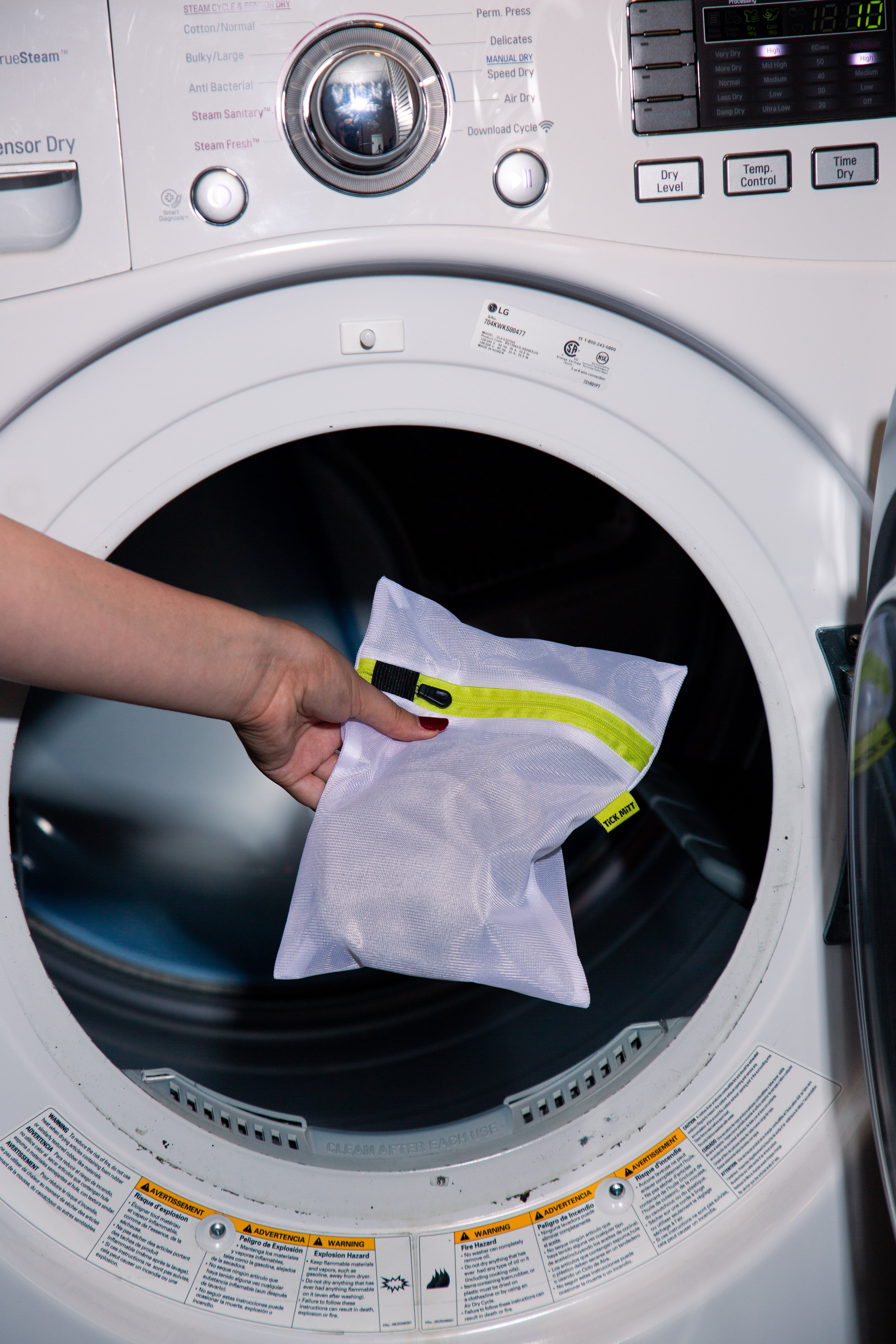
Protect the entire family
Skin, clothing, and fur — the same mitt handles all three. Most families keep one by the back door for people and a second one for the dog.
It works like Velcro
No sprays, no pesticides, no permethrin, no harsh ingredients — the fabric does the work. You already read every label in the house. This one is short.
You've probably already seen us.




Featured on Shark Tank, Good Morning America and The View · Named to the TIME Best Inventions 2025 list.
100,000+ families already do this.
Real reviews from customers who bought TiCK MiTT hoping it would work — and then it did.
It grabbed five ticks off our dogs
"We stopped at a hotel and took the dogs down a mowed path through a field of weeds. Thirty minutes in, my husband and I both had ticks on us. I pulled out the TiCK MiTT — honestly an impulse buy — and it grabbed about five ticks off the dogs and kept them all stuck on the glove. We checked again at home and found nothing else. I am impressed, to say the least."
Verified buyer
· Road trip with two dogs
Easy to use — like magic
"I ordered two sets with the removal tool and I am thrilled. I gave one to a girlfriend who has had an ongoing problem with tick bites. We both live in the woods and have an active tick season. It is easy to use, and I use one of the mitts for the dog too. The mitt attracts the ticks right off of you if they haven't bitten in yet — like magic."
Verified buyer
· Bought the MiTT + SiDEKiCK set
At least one tick every week
"We have purchased three of these mitts and they work great. We wipe down the dogs after every walk and without fail we will find at least one tick per week. I wish you made a bed cover out of this material — I would definitely buy that as well."
Verified buyer
· Repeat customer, three mitts
The honest answers.
Sources: CDC estimates for annual tick bites, Lyme disease diagnoses and alpha-gal syndrome prevalence; CDC Powassan virus surveillance (2015 and 2025 reported cases); CDC tick-bite emergency department tracking, 2025.
If one already bit, you need TiCK SiDEKiCK.
TiCK MiTT catches loose ticks before they bite — it does not remove embedded ones. That's what SiDEKiCK is for.

A tick that's already attached needs to come out whole, and it needs to come out now — Powassan can transmit in as little as 15 minutes. SiDEKiCK is a compact 3-in-1 stainless-steel extractor with an integrated flashlight, so you can see what you're doing on a squirming kid, a dog, or a cat at dusk on the back steps.
Three tools in one — fine tip, notch, and scoop for ticks of any size
Built-in flashlight so you can find it in fur, hair, and low light
Stainless steel, pocket-sized — lives in the glovebox or the hiking pack
Get the tick-season checklist.
Where to check on your family and pets, what a bite looks like on day one, and when to call your doctor. One email, no spam.


