
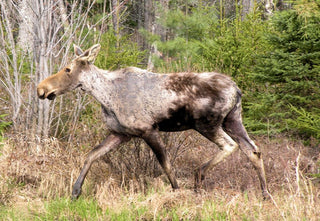
In Utah's Wasatch Mountains right now, moose are dying in a way that's hard to imagine. Not from predators, not from disease in the traditional sense — but from ticks. Thousands of them. Sometimes tens of thousands on a single animal.
Kent Hersey, a researcher with the Utah Division of Wildlife Resources, told the Salt Lake Tribune that moose are being "sucked to death" — drained so severely of blood that some die of malnutrition, while others become so weak they can barely walk and must be euthanized. "Just a handful of them isn't a huge deal," Hersey said, "but some of these animals have thousands of ticks, over 10,000 ticks on them."
Utah's moose population sits just under 3,000 animals. The DWR has placed GPS collars on roughly 60 cow moose and calves and begun counting tick loads to track exactly where and when infestations are occurring. The picture emerging is alarming — and Hersey believes 2026 could be especially bad. A lack of snow this winter, he warned, may create a "huge year" for ticks because fewer die off in cold, snowy conditions.
It's a dramatic story. But it's also a window into a larger problem — one that doesn't stop at wildlife.
First: The Important Distinction
The ticks killing Utah's moose are winter ticks (Dermacentor albipictus) — also called moose ticks. According to Cornell University's Wildlife Health Lab, winter ticks rarely bite humans and do not carry diseases transmissible to people. They are a one-host species that spend their entire life cycle on large ungulates like moose, elk, deer, and caribou. They are not the ticks in your backyard.
This matters: the Utah moose crisis is not a direct human health story. It is a wildlife conservation crisis driven by the same underlying force that is making tick season more dangerous for your family — warming winters.
What Warming Winters Do to ALL Tick Populations
Ticks of every species depend on cold winters as a natural population control. When winter temperatures stay consistently cold, tick survival rates drop and populations are kept in check. As winters have become shorter and milder across North America, that natural check has weakened — with consequences that extend well beyond moose.
Hersey's warning about Utah — that low snowpack and warmer conditions will produce a "huge year" for ticks — reflects the same dynamic that infectious disease experts are observing for the black-legged ticks that carry Lyme disease.
Research published in Science and reported by the American Association for the Advancement of Science found that black-legged ticks infected with Lyme disease bacteria actually thrive in below-freezing weather and can remain active even in winter — surviving cold at higher rates than uninfected ticks. The study found that about 79% of Lyme-infected ticks survived winter conditions, compared to roughly 50% of uninfected ticks.
"Once it warms up for even a couple of days, ticks become active," Dr. Charles Bourque of Boston University told BU Today. "And that could happen really at any time of the year now. Lyme transmission can occur really in any month."
Dr. Cassandra Pierre, an infectious disease expert at Boston University School of Medicine and Boston Medical Center, put it plainly: "We have warmer winters and earlier springs and there's humidity that comes with that. Ticks love warmer, wetter climates. And not only do they love that, but their hosts tend to as well. The deer, the mice — when their ranges and numbers increase, we absolutely are going to see an expansion of ticks."
Maine's Moose: A Preview of What Warming Winters Produce at Scale
Utah isn't the only state watching this play out. Maine has the largest moose population in the lower 48 states — and a stark data point on what warming winters produce at scale. In the winter of 2021, the Maine Department of Inland Fisheries and Wildlife collared 70 moose calves. By the following May, 60 of them had died, according to Maine Public reporting. Tick infestation, driven by milder winters that allowed more ticks to survive, was the primary cause.
The mechanism is straightforward: when winters are cold enough, large numbers of questing tick larvae die before finding a host. When winters are mild, more larvae survive, find hosts, and complete their life cycle — producing more eggs, more ticks, and more disease risk the following season.
What This Means for Your Family's Tick Risk
The same pattern driving moose die-offs in Utah and Maine is driving the tick population explosion that the CDC is now tracking in the form of record emergency room visits. In early April 2026, the CDC reported that 71 out of every 100,000 ER visits nationally were for tick bites — the highest rate in nearly a decade. In the Northeast, that figure jumped to 163 per 100,000.
Michigan's confirmed Lyme disease cases nearly quadrupled between 2022 and 2025 — a surge that Michigan State University tick disease ecologist Jean Tsao directly links to tick populations exploding in areas where people live. New York State averages more than 17,500 new Lyme cases annually.
Research reported by PBS NewsHour found that the incidence of Lyme disease in the United States has more than doubled over the last 24 years as black-legged tick populations have expanded their range. A 2021 review of climate modeling studies found that black-legged ticks are expected to spread farther northward across the Dakotas, northern Minnesota, and into Canada by 2050.
The trend is not a future projection. It is already underway — visible in Utah's dying moose, in Maine's devastated calf cohorts, and in the CDC's ER data from this spring.
The Individual Response to a Population-Level Problem
There is no individual solution to a warming climate. But there is a meaningful individual response to expanded tick risk — and it comes down to habit and preparation.
Tick season in many parts of the country is now effectively year-round. Checks after outdoor activity matter in January as much as in July. Ticks are active in city parks, suburban backyards, and hiking trails alike. The black-legged tick that carries Lyme disease is now documented in 70% of New York City parks, according to a Columbia University study.
The protective routine that infectious disease experts consistently recommend:
- Check for ticks thoroughly after any outdoor activity — scalp, hairline, behind the ears, underarms, groin, behind the knees, between the toes
- Put outdoor clothes in a hot dryer for 10 minutes immediately after coming inside
- Remove any attached tick immediately and correctly — grasping close to the skin, pulling steadily upward, never squeezing or twisting the body
- Monitor for symptoms (bull's-eye rash, fever, fatigue, joint aches) in the 3 to 30 days after a known bite
Having the right removal tool on hand before you need it is part of that preparation. TiCK MiTT is a chemical-free, scientifically-developed fabric glove that removes ticks from people and pets safely in seconds — no chemicals, no tweezers, safe for kids and the whole family.
The forces making Utah's moose vulnerable are the same forces making tick season longer, more intense, and more geographically widespread for families across the country. The response starts with being ready.
Available at Petco, Bass Pro Shops, and tickmitt.com.
→ [Shop TiCK MiTT — Be Ready for a Longer, More Active Tick Season]
Sources: Salt Lake Tribune / Kent Hersey, Utah Division of Wildlife Resources (Utah moose reporting); Maine Public (Maine moose calf mortality); Cornell University Wildlife Health Lab (winter tick species information); University of Maine Cooperative Extension (winter tick); Science/AAAS (black-legged tick winter survival research); Boston University / Dr. Cassandra Pierre and Dr. Charles Bourque (warming winters and tick season); PBS NewsHour science reporting (Lyme disease incidence doubling); CDC (tick bite ER visit data, 2026); Michigan Department of Health and Human Services / Jean Tsao, MSU (Michigan Lyme surge); Columbia University (NYC parks tick study)


