
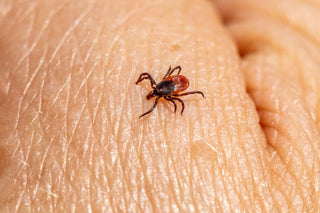
Your dog is one of the best early warning systems you have for tick activity around your home. They walk through the same grass, brush, and wooded edges where ticks wait — and unlike you, they can't tell you when something feels wrong.
Tick-borne diseases are a serious and growing threat to pet health across the United States. As the CDC reports tick bite-related ER visits at their highest rate in nearly a decade, veterinary experts are seeing parallel increases in tick exposure among companion animals. The ticks most dangerous to your pets are active across most of the country — and several of them can cause diseases that are fatal if not caught early.
Here is what every dog and cat owner needs to know.
How Ticks Affect Pets
According to the Morris Animal Foundation, most tick-borne diseases that affect humans also affect dogs. Some diseases are dog-specific. Cats are less commonly affected but are not immune — and even indoor cats face exposure if they share a home with a dog that goes outside, since ticks can transfer between co-housed pets, according to the Companion Animal Parasite Council (CAPC).
Ticks cause harm to pets in two ways: directly, through skin lesions, blood loss, and in rare cases tick paralysis; and indirectly, by transmitting bacterial, viral, and parasitic diseases through their bite.
Critically, dogs often don't react visibly to tick bites. According to PetMD, ticks release a substance in their saliva that makes the bite painless, so your dog may show no sign that a tick is feeding. Regular, thorough tick checks are the only way to catch them.
The Ticks Most Dangerous to Your Pets
1. Black-Legged Tick (Deer Tick) — Ixodes scapularis / Ixodes pacificus
Where found: Eastern and Midwestern US (I. scapularis); Pacific Coast (I. pacificus) Diseases transmitted to pets: Lyme disease, anaplasmosis, babesiosis
The black-legged tick is the primary carrier of Lyme disease — the most common tick-borne illness in both humans and dogs in the US, according to the Morris Animal Foundation. In dogs, Lyme disease causes fever, joint swelling, lameness, lethargy, and in serious cases, potentially fatal kidney failure. The disease has been diagnosed across most of the continental United States and has never been reported in cats.
Anaplasmosis, also transmitted by the black-legged tick, is sometimes called "dog fever." According to the AKC Canine Health Foundation, symptoms include fever, loss of appetite, stiff joints, lethargy, vomiting, diarrhea, and in extreme cases, seizures. The western black-legged tick (I. pacificus) along the Pacific Coast carries the same disease risk.
Nymph-stage black-legged ticks are particularly dangerous because they are approximately the size of a poppy seed and extremely easy to miss on a dog's coat.
2. Brown Dog Tick — Rhipicephalus sanguineus
Where found: Worldwide; throughout the entire US Diseases transmitted to pets: Rocky Mountain spotted fever (southwestern US and along the US-Mexico border), anaplasmosis, ehrlichiosis, babesiosis, bartonellosis, hepatozoonosis
The brown dog tick is unique among US tick species in one critical way: its life cycle allows it to survive and reproduce entirely indoors, according to the Illinois Department of Public Health. This means it can establish infestations in kennels, homes, and shelters — surviving in cracks, behind radiators, under rugs and furniture, and along walls — even in cold climates where it cannot survive outdoors.
Dogs are its preferred host at every life stage. According to VCA Animal Hospitals, both immature and adult brown dog ticks prefer dogs and can be active in homes year-round. The tick is identifiable by its reddish-brown coloring and, in females, the ability to engorge to half an inch in length.
The AKC Canine Health Foundation lists canine bartonellosis — transmitted by the brown dog tick — as capable of causing heart or liver disease if left untreated. Canine hepatozoonosis, transmitted by ingestion of an infected brown dog or Gulf Coast tick rather than through a bite, causes severe pain, muscle wasting, anemia, and is often fatal, according to the AKC.
3. American Dog Tick — Dermacentor variabilis
Where found: East of the Rocky Mountains; limited populations on the Pacific Coast Diseases transmitted to pets: Rocky Mountain spotted fever, tularemia, ehrlichiosis
Rocky Mountain spotted fever is one of the most serious tick-borne diseases due to its rapid onset and high fatality rate, according to the Morris Animal Foundation. Dogs are far more likely to be affected than cats. Symptoms in dogs include fever, poor appetite, swollen lymph nodes, joint pain, and in some cases neurological signs including wobbliness. The disease has a wide distribution across the US despite its regional name.
The American dog tick is identifiable by its chestnut brown coloring with white spots or streaks. Engorged females become slate gray and expand to approximately half an inch. Adults are most active from April through early August and are most often found in grassy areas, low vegetation, and along trails and paths.
4. Lone Star Tick — Amblyomma americanum
Where found: Eastern, southeastern, and south-central United States; range expanding Diseases transmitted to pets: Ehrlichiosis, tularemia, Rocky Mountain spotted fever; also a vector of alpha-gal syndrome in humans
The lone star tick is identifiable by the single white dot on the female's back. All life stages — larva, nymph, and adult — will bite dogs, according to veterinary sources, making it harder to avoid at any time of year. The lone star tick's range is expanding across the eastern US, tracking with growing white-tailed deer populations.
In humans, the lone star tick is the primary carrier of alpha-gal syndrome (AGS) — a potentially life-threatening allergy to red meat and mammalian products. In 2024, a New Jersey pilot died after eating a hamburger while unknowingly carrying the condition. Importantly, dogs and cats cannot develop AGS themselves because they already carry the alpha-gal molecule in their bodies, according to the CDC. However, a lone star tick that feeds on your dog can easily transfer to you or your children.
Ehrlichiosis, transmitted to dogs by the lone star tick, causes fever, loss of appetite, lethargy, and bleeding abnormalities including nosebleeds and bruising, according to the AKC Canine Health Foundation. It has a chronic form that is much harder to treat if not caught early.
5. Gulf Coast Tick — Amblyomma maculatum
Where found: Southeastern United States along the Gulf and Atlantic coasts, north to Maryland; focal populations elsewhere Diseases transmitted to pets: Rickettsia parkeri rickettsiosis (spotted fever); hepatozoonosis via ingestion
The Gulf Coast tick is found along coastal southeastern states and is associated with transmission of a form of spotted fever in humans. In dogs, it is notable as a vector of American canine hepatozoonosis — a severely debilitating disease acquired when a dog ingests an infected tick, not through a bite. Symptoms include pain, reluctance to move, fever, and muscle wasting. The disease is generally found in the southern United States and is considered often fatal, according to the AKC.
6. Rocky Mountain Wood Tick — Dermacentor andersoni
Where found: Rocky Mountain states and southwestern Canada Diseases transmitted to pets: Rocky Mountain spotted fever, Colorado tick fever, tularemia; can cause tick paralysis
Found primarily in the Rocky Mountain states, this tick is the primary vector of Rocky Mountain spotted fever in that region. It is also one of the tick species capable of causing tick paralysis — a condition where tick saliva toxins cause progressive muscle weakness and, in severe cases, respiratory failure. Tick paralysis resolves rapidly once the tick is removed. According to the Morris Animal Foundation, dogs are much more likely to be affected by Rocky Mountain spotted fever than cats.
7. Western Black-Legged Tick — Ixodes pacificus
Where found: Pacific Coast states Diseases transmitted to pets: Lyme disease, anaplasmosis, babesiosis
The western equivalent of the deer tick, Ixodes pacificus is the primary Lyme disease vector on the West Coast. According to Mayo Clinic, it carries the same disease profile as its eastern counterpart — Lyme disease, anaplasmosis, and babesiosis — and poses the same risk to dogs in California, Oregon, and Washington.
8. Asian Longhorned Tick — Haemaphysalis longicornis
Where found: Eastern US — first detected in New Jersey in 2017; as of 2025, found in at least 22 states including New York, Virginia, Pennsylvania, North Carolina, and Michigan, among others Diseases transmitted to pets: Disease transmission in North American pets not yet fully established; in other countries, transmits severe fever with thrombocytopenia syndrome virus (SFTSV)
The Asian longhorned tick is an invasive species that has spread rapidly across the eastern United States since its first detection in New Jersey in 2017. According to VCA Animal Hospitals, it has been found on cats, dogs, livestock, and people. It is unique among US tick species in that females reproduce without mating, meaning a single tick can establish an infestation.
While its capacity to transmit known North American diseases is still being studied — one experimental study found it is unlikely to spread Lyme disease bacteria in the US — laboratory research has found it can carry Rocky Mountain spotted fever bacteria. In Asia, where it is native, it transmits a potentially fatal viral illness. Mayo Clinic notes that the risk of illness in humans and pets from its bite in the US remains under active investigation.
Where Ticks Hide on Your Pet
Knowing where to look dramatically improves the effectiveness of a post-outdoor tick check. According to peer-reviewed research published in Parasites & Vectors, attachment sites on dogs vary by tick species:
- Lone star ticks most commonly attach to the abdomen, armpit, and groin area
- American dog ticks and deer ticks most commonly attach to the head, neck, and back
- Brown dog ticks attach to the head, neck, abdomen, legs, and feet — including between the toes and around the ears
For cats, deer ticks most commonly attach to the head, while lone star ticks favor the tail and perianal region.
Always check between the toes, around the ears and collar area, under the "armpits," and around the tail base after any outdoor activity.
What to Do If You Find a Tick on Your Pet
Remove it immediately. Every hour of attachment increases transmission risk for most tick-borne diseases. The CAPC recommends using fine forceps or a purpose-designed tick removal tool — grasping as close to the skin as possible and pulling steadily upward without twisting or squeezing the body. Clean the area with antiseptic after removal.
Do not use petroleum jelly, nail polish, or heat — these methods can cause the tick to regurgitate into the wound, increasing infection risk. Save the tick in a sealed container in case your veterinarian needs it for identification.
Monitor your pet in the weeks following a tick bite for: lethargy, loss of appetite, fever, limping or joint swelling, nosebleeds or unusual bruising, pale gums, or neurological symptoms. Contact your veterinarian promptly if any of these appear.
Talk to your veterinarian about tick prevention medications — monthly topicals, tick collars, and oral preventives are all options that can significantly reduce infestation risk.
The Tool Built for Fast, Safe Removal
TiCK MiTT is a chemical-free, scientifically-developed fabric glove that removes ticks from people and pets safely in seconds. No tweezers, no chemicals, no risk from improper removal. Available in adult and Kids sizes.
As tick populations expand across the US and more species establish themselves in new regions, having a reliable removal tool on hand — before you need it — is part of responsible pet ownership.
Available at Petco, Bass Pro Shops, and tickmitt.com.
Shhop TiCK Prevention and Removal Bundles and save
Sources: Morris Animal Foundation (canine tick-borne disease); VCA Animal Hospitals (ticks in dogs); AKC / AKC Canine Health Foundation (tick-borne disease in dogs); Companion Animal Parasite Council (CAPC); PetMD (tick species in dogs); Mayo Clinic (tick species guide); CDC (tick species distribution, alpha-gal syndrome); Illinois Department of Public Health (brown dog tick); Parasites & Vectors / NIH (tick attachment sites on pets, peer-reviewed); PMC / NIH (ticks infesting dogs and cats in North America, peer-reviewed)


