
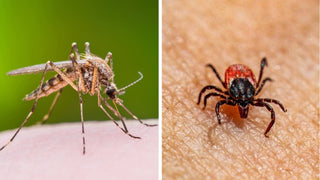
New York is heading into one of the most active tick and mosquito seasons in recent memory — and experts say the risk is no longer limited to upstate trails and Long Island backyards. It's in the city itself.
Byron Backenson, director of the Bureau of Communicable Disease Control at the New York State Department of Health, told the New York Post that he wouldn't be surprised to see more ticks this year than last. He has heard reports of ticks in Central Park and Prospect Park — which aligns with a Columbia University study finding that ticks now inhabit 70% of NYC parks and are latching onto dogs across the five boroughs.
For New Yorkers who hike, walk dogs, or spend time in any green space this spring and summer, the message from public health officials is clear: the threat is real, it is closer to home than most people realize, and protection is your responsibility.
The Tick Situation in New York Right Now
Tick bites are sending Americans to the emergency room at the highest rate in nearly a decade, according to new CDC data. In early April, 71 out of every 100,000 ER visits nationally were for tick bites. In the Northeast — which includes New York — that number jumped to 163 out of every 100,000 ER visits, up from 52 in March.
While tick exposure is more common in the Hudson Valley and other rural areas, Backenson confirmed that tick populations have now been documented in all five New York City boroughs. The black-legged tick — the primary carrier of Lyme disease — has established strongholds on Staten Island and parts of the Bronx.
New York State has averaged more than 17,500 new Lyme disease cases annually over the last three years, with 19,000 recorded in 2023 alone. "When I was working on Lyme disease stuff almost 30 years ago, it was not a great big issue outside of Long Island and the areas sort of just north of New York City," Backenson told the Post. "Over the course of that particular 30 years, we have seen the risk of acquiring Lyme move further North and further West across New York."
The Long Island Tick Problem
Long Island has long been one of the highest-risk tick areas in New York State. The Lone Star tick — an aggressive species identifiable by the white dot on the female's back — is prevalent on Long Island and is the primary carrier of alpha-gal syndrome, a potentially fatal meat allergy. In 2024, a New Jersey pilot died after eating a hamburger while unknowingly carrying this condition.
Long Island ticks also carry babesiosis, Rocky Mountain spotted fever, and other tick-borne diseases in addition to Lyme.
The Mosquito Threat Is Growing Too
New York's tick surge is happening alongside a significant mosquito problem. The Asian tiger mosquito — which arrived in the US in the 1980s and established itself in NYC in the mid-2000s — continues to expand across the city.
Laura Harrington, program director of the CDC Northeast Regional Center for Excellence in Vector-borne Diseases and a Cornell University entomologist, told the Post that the mosquito's activity period is extending deeper into the year: "Its activity period is going longer and longer into November, even. We'll see adults flying around in New York and so that's very unusual."
West Nile Virus remains the primary mosquito-borne disease concern in the city, present in all five boroughs, with cases running 40% higher than normal as of last fall. In October 2025, health officials confirmed the first locally acquired case of chikungunya — a tropical disease causing fever and joint pain — in Nassau County, Long Island.
Why Tick Control Is So Much Harder Than Mosquito Control
One of the most important things New Yorkers can understand about tick risk is that the public health tools used for mosquitoes don't work for ticks.
"I've been in this since 1992, and we still don't have really great area-wide control for ticks," Backenson told the Post. "Spraying measures used for mosquitoes are ineffective for ticks."
For mosquitoes, the NYC Health Department conducts active surveillance and applies pesticides when needed. For ticks, protection falls almost entirely on the individual.
How to Protect Yourself and Your Family in New York
Backenson's personal recommendations, as shared with the New York Post:
- Wear light-colored, long-sleeved clothing when in wooded or grassy areas
- Treat gear with permethrin
- Tuck pants into socks
- Do exhaustive tick checks after being outdoors — especially in late spring and early summer, when nymph-stage ticks can be the size of a poppy seed
- Throw clothes into a hot dryer for 10 minutes after outdoor activity to kill any ticks that may be clinging to fabric
For mosquitoes: use DEET-based repellents and eliminate standing water near your home, which is a primary mosquito breeding ground.
A potential Lyme disease vaccine has shown over 70% efficacy in trials and is in development, but no approval timeline has been provided. Until it is available, individual vigilance is the only reliable protection.
The Tool That Makes Tick Checks Faster and Safer
TiCK MiTT is a scientifically-developed fabric glove that removes ticks safely in seconds — no chemicals, no toxins, safe for children and pets. As Backenson and other experts emphasize, quick and correct removal is one of the most effective tools available to individuals. TiCK MiTT makes that removal fast and accessible whether you're checking a child after a day in Prospect Park or a dog after a walk on Staten Island.
Featured on Shark Tank Season 16 and named a TIME Best Invention. Available at Petco, Bass Pro Shops, and tickmitt.com.
→ [Shop TiCK MiTT — Chemical-Free Tick Removal for New York Families]
Sources: NY Post; CDC; New York State Department of Health


