
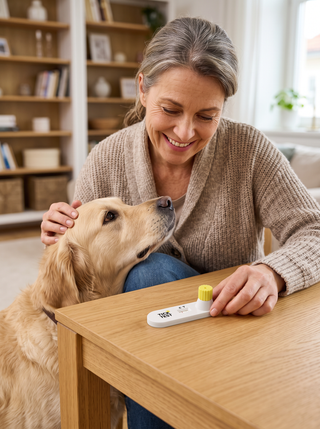
After a tick bite, the instinct is usually to get rid of the tick itself as fast as possible – and understandably so – but that leaves an open question: was it even carrying anything? At-home Lyme tests have become a popular way to get an answer without an ER visit or a wait for a doctor's appointment. They can be genuinely useful, but they're also widely misunderstood. Knowing what an at-home Lyme test can actually tell you, and, just as importantly, what it can't, makes the difference between using one well and either panicking over a false alarm or being falsely reassured too early.
What at-home Lyme tests measure
At-home Lyme tests are antibody tests, sometimes called serology tests. Rather than detecting the Borrelia burgdorferi bacteria (the primary cause of Lyme) directly, they measure two types of antibodies your immune system produces in response to it: IgM and IgG antibodies. Most kits work by having you collect a small blood sample from a fingerstick, which you then mail to a lab for analysis; operating using the same basic method as a clinical antibody test, just done from home.
Timing matters enormously here. According to MedlinePlus, a service of the National Library of Medicine, it can take a few weeks for your body to produce enough antibodies to be detectable at all – which is exactly why testing too early produces a "false negative": you may already be infected, but your immune system hasn't caught up yet. IgM antibodies are typically the first to appear, usually within one to two weeks of infection, while IgG antibodies take longer to develop, generally showing up around four to six weeks after exposure, per Testing.com. Both types can persist in the blood for years afterward, which is part of why a positive result isn't as simple as it sounds.
Why standard testing misses so many early cases
This timing gap isn't a minor technicality – it's the central weakness of Lyme testing today. The standard two-tier testing method recommended since 1995 (an initial screening test followed by a confirmatory Western blot) has documented limits on sensitivity in early-stage disease. A 2026 study published in Microbiology Spectrum, conducted by IGeneX in partnership with the Bay Area Lyme Foundation's Lyme Disease Biobank, found that standard two-tier and modified two-tier testing methods miss an estimated 64% to 78% of early Lyme disease cases. In that same study, a newer single-step immunoblot test detected antibodies in 58.3% of early-stage
CDC sample cases, compared to just 30.0% for standard two-tier testing, nearly doubling the detection rate during the window when treatment matters most.
That's a meaningful shift, but it's worth being clear about what it does and doesn't solve. Even improved antibody tests are still measuring your immune response, not the bacteria itself, which means timing still matters. No antibody-based test, at home or in a clinic, can reliably rule out early Lyme disease if it's taken too soon after a bite.
How to actually read your results
A few things are worth keeping in mind so a result doesn't cause more confusion than clarity:
A negative result taken early isn't the final word. If you test within the first couple of weeks after a bite and get a negative, that doesn't necessarily mean you're in the clear – your body may simply not have produced enough antibodies yet. MedlinePlus specifically advises retesting if symptoms persist and your first test was taken less than 30 days after possible exposure.
A positive result doesn't automatically mean an active infection. Because antibodies can linger for months or years, a positive test can reflect a past infection your body already fought off – not necessarily a current one. This is one of the more counterintuitive parts of Lyme testing, and it's exactly why a positive at-home result should prompt a conversation with a doctor rather than an immediate assumption.
Confirm with a lab, not just the at-home kit alone. The CDC recommends a second, different test to confirm any initial positive result. MedlinePlus also cautions that some at-home test kits use laboratory methods that haven't been proven reliable, so it's worth checking with your provider before relying on an at-home result on its own, and following up with confirmatory lab testing if the result is positive or if symptoms continue despite a negative.
Symptoms plus exposure history matter as much as the number on the page. Lyme disease diagnosis was never meant to rest on a lab result in isolation. A doctor will weigh your test result alongside your symptoms, when and where you may have been bitten, and how long ago that was.
The bottom line
At-home Lyme tests are a useful first step, not a final answer. They're most informative when you understand the testing window, treat an early negative with appropriate caution, and follow up on any positive result with your doctor rather than making decisions based on the at-home result alone. As diagnostic technology improves with newer, more sensitive testing methods entering clinical use, the accuracy gap in early Lyme detection is starting to close. Until then, informed patience and the right follow-up steps are still the best tools available.
Frequently Asked Questions
How accurate are at-home Lyme disease tests? At-home Lyme tests use the same antibody-detection methods as standard clinical serology tests, which means they carry the same limitations – particularly reduced accuracy in early-stage infection, when antibody levels haven't yet risen enough to detect.
How soon after a tick bite can you test positive for Lyme disease? It typically takes one to two weeks for IgM antibodies to become detectable, and four to six weeks for IgG antibodies to develop. Testing before your body has produced enough antibodies can result in a false negative.
Can you get a false negative on a Lyme disease test? Yes. Testing too soon after exposure is the most common cause of a false negative, since antibody levels may not yet be high enough to detect. If symptoms continue, retesting a few weeks later is generally recommended.
Does a positive Lyme test always mean I have an active infection? Not necessarily. Antibodies can remain in your blood for years after a past infection has resolved, so a positive result should be interpreted alongside your current symptoms and exposure history, not on its own.
What's the difference between IgM and IgG in a Lyme test? IgM antibodies typically appear first, within one to two weeks of infection, while IgG antibodies take longer to develop, usually four to six weeks after exposure. Both can be present for an extended period afterward.
Are there new, more accurate Lyme disease tests available? Yes. Newer single-step immunoblot tests have shown meaningfully improved detection rates in early-stage Lyme disease compared to standard two-tier testing, though they still work by detecting antibodies rather than the bacteria itself.
Sources: MedlinePlus (National Library of Medicine); Testing.com; IGeneX/Microbiology Spectrum study via GlobeNewswire; Origins of Health.


