
The honest answer to the question everyone asks after pulling a tick off, including the part most articles skip.
The tick is off. It's in a bag. And now there's a question sitting in your mind that you probably typed into your phone one-handed while still holding the tweezers.
Can I find out if the tick is carrying any diseases, like Lyme disease?
Yes, you can. Ticks can be tested for the bacteria that causes Lyme disease, and testing has gotten dramatically faster in the last year.
But there's a second half to that answer, and skipping it is how people end up either falsely reassured or unnecessarily terrified. So let's talk about the process.
You can test a tick. Here's what that actually means.
A tick test analyzes the tick you removed. It looks inside that insect for pathogens, most commonly Borrelia burgdorferi, the bacteria responsible for Lyme disease.
What it does not do is test you to see if the pathogen has transmitted. That's a completely different test, looking for a completely different thing — antibodies your immune system produces in response to an infection, which can take several weeks to become detectable.
So a tick test can tell you whether the pathogen being tested for was detected in that tick.
Human Lyme disease testing looks for evidence of the body’s immune response to infection and is interpreted by a healthcare provider alongside symptoms and exposure history. Because antibodies can take several weeks to become detectable, testing too early may produce a negative result even when an infection is present.C
The part people skip: a positive tick is not an infection
This is the single most important thing on this page.
A positive TiCK TEST result means Borrelia burgdorferi, the primary bacterium that causes Lyme disease in the United States, was detected in the tick. It does not mean the bacteria were transmitted to you or that you have Lyme disease.
The likelihood of transmission can depend on factors including the tick species and how long it was attached. Prompt removal of an attached tick is recommended. Prompt, proper removal is important: the CDC recommends grasping the tick as close to the skin as possible with fine-tipped tweezers and pulling upward with steady, even pressure.
A negative result also has a specific meaning: B. burgdorferi was not detected in the tick tested. It does not test you for Lyme disease or rule out exposure to other tickborne pathogens. Think of your TiCK TEST result as one important piece of information following a tick bite—not a diagnosis. If you develop symptoms or have concerns about the bite, contact a healthcare provider and share information about the tick, the bite, and your test result.
What can a tick test tell you?
Testing a removed tick can provide information about whether the pathogen being tested for was detected in that tick. However, the CDC advises against using tick-testing results to make treatment decisions. A positive result does not establish that transmission occurred, and a negative result should not be used to rule out infection.
If you have concerns after a tick bite, contact a healthcare provider and share information such as when and where the bite occurred and, if known, how long the tick may have been attached. Do not wait for a tick-test result if symptoms develop.
How to test a tick for Lyme disease
Option 1: At-home rapid testing
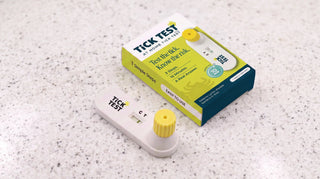
A single-use test you run yourself. Narrower scope — one pathogen instead of a panel — but the answer comes in minutes instead of days. An at-home tick test produces a result in about 10 minutes and costs $34.99.
TiCK TEST works like this: place the removed tick in the device, add buffer, turn the grinder clockwise to crush the tick, add buffer again and cap it. Read the strip. A positive can show as early as 5 minutes; a negative is confirmed at 10. Don't read it after 15.
Initial testing showed greater than 99% accuracy. It's $34.99, and it analyzes ticks only — it does not diagnose Lyme disease in people or pets.
Option 2: Mail-in laboratory testing
Labs including TickReport (UMass Amherst), the PA Tick Research Lab, Ticknology, and Upstate Tick Testing Laboratory run PCR panels on submitted ticks. These typically cover multiple pathogens and often include species identification. Cost generally starts around $59. Turnaround is usually 24 hours to about a week after the tick arrives, so shipping adds to the clock.
Best for: breadth of pathogens, species ID, contributing to surveillance data.
Option 3: Talk to your doctor regardless
If you’re concerned about a tick bite, contact a healthcare provider. In certain circumstances, antibiotics after a tick bite may be appropriate, and that decision should be made with a healthcare professional.
Save the tick. Seriously.
Whatever you decide about testing, do this part:
- Keep the tick. If you plan to test it, follow the storage and handling instructions provided by the testing service.
-
Write the date on it. And where on the body you found it.
- Take a photo. Species matters, and a photo survives even if the tick doesn't.
- Watch for symptoms for several weeks. Expanding rash, fever, chills, headache, fatigue, joint pain, facial weakness. Don't wait on a test result if any of these show up.
The best test is the one you never need
We'd rather you never got to this page.
Every one of these options exists downstream of a bite that already happened. The thing that actually moves the needle is finding ticks before they attach — and that's still a habit, not a product breakthrough.
A tick check after every hike. After the dog park. After an hour of yard work. Making tick checks part of your post-outdoor routine can help you find ticks before they attach.
TiCK MiTT exists to make that habit easier to keep. It’s a reusable, chemical-free tick-checking mitt designed to help catch loose, crawling ticks from skin, clothing and pet fur before they attach.
It feels like petting your dog. Just with purpose.
Find them first. Test what you find. And call your doctor with information instead of a guess.
More reading: I Found a Tick. Now What? · At-Home vs. Mail-In Tick Testing vs. Lyme Blood Tests · How Long Does a Tick Have to Be Attached to Transmit Lyme Disease? · Tick & Lyme Disease Resources
Frequently Asked Questions
Can you test a tick for Lyme disease?
Yes. A tick can be tested for Borrelia burgdorferi, the bacteria that causes Lyme disease, either through a mail-in laboratory PCR panel or through a rapid at-home test. Tick testing analyzes the tick itself and is not a medical diagnosis of the person or animal bitten.
How do you test a tick for Lyme disease at home?
Rapid at-home tick tests use a lateral flow strip. With TiCK TEST, you place the removed tick in the device, add buffer, turn the grinder to crush the tick, add buffer again, cap it, and read the strip. A positive result can appear as early as 5 minutes and a negative is confirmed at 10 minutes.
Does a tick need to be alive to be tested?
No. Tick testing detects pathogen material inside the tick, so a dead tick can still be tested. Store it dry in a sealed bag or container rather than in alcohol if you plan to test it, and label it with the date you removed it.
How accurate is tick testing?
Accuracy varies by method. Laboratory PCR testing is highly accurate for the pathogens on its panel. TiCK TEST demonstrated greater than 99% accuracy in initial testing. No tick test, however accurate, tells you whether transmission to a person occurred.
If the tick tests positive for Lyme, do I have Lyme disease?
No. A positive tick-test result means the bacterium was detected in the tick tested; it does not mean transmission occurred or that you have Lyme disease. A healthcare provider can evaluate your individual risk based on factors such as the type of tick, possible attachment time, geographic exposure and any symptoms.
Why does the CDC caution against tick testing?
The CDC advises against using tick test results to guide treatment decisions because a positive result does not confirm that transmission occurred, while a negative result can create false reassurance. Tick testing analyzes the tick itself and should not be used to diagnose or rule out Lyme disease in the person who was bitten.
How long should I watch for symptoms after a tick bite?
Watch for several weeks regardless of any test result. Seek care promptly if you develop an expanding rash, fever, chills, headache, fatigue, muscle or joint pain, facial weakness, or a swollen joint.
Updated: September 2026


